


How AI is transforming corporate language training (and what it will never replace)
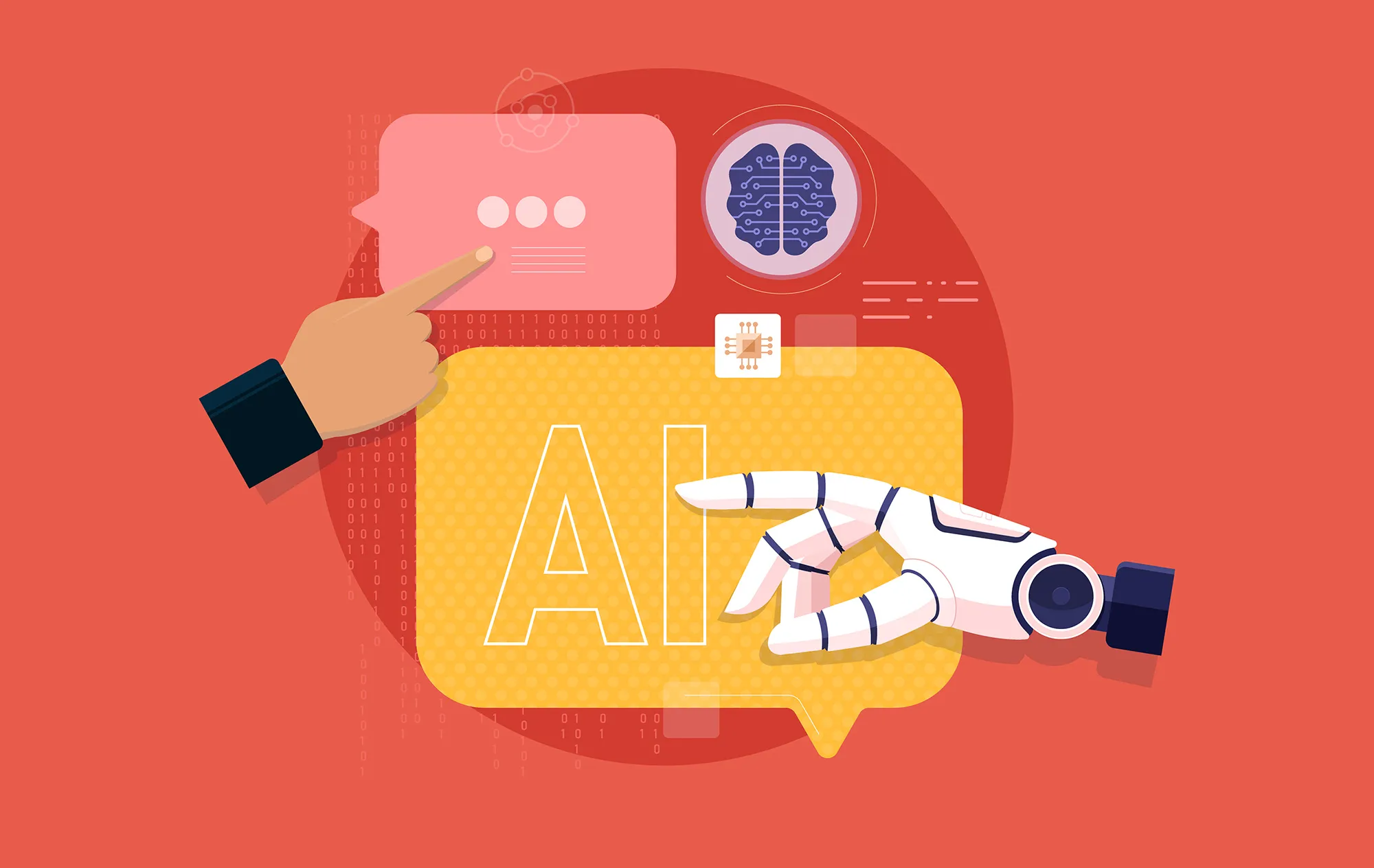
Artificial intelligence has invaded almost every sector of professional training, and language training is no exception. Conversational assistants, automatic pronunciation correction, adaptive microlearning, real-time error analysis: the promises are many, and some are very real.
But behind the technological enthusiasm, HR managers and training decision-makers are asking a legitimate question: what is AI really changing in language training? And above all, can it be relied upon to train professional teams with real-world issues at stake?
Here’s our answer, frank and nuanced, after fifteen years of training professionals in Belgium.
What AI can do for you
1. On-demand practice, 24 hours a day
This is undoubtedly the most immediately useful contribution of AI to corporate language learning: the ability to practice at any time, without being dependent on a collective agenda.
An employee who has just returned from a long day and wants to practice speaking English for 20 minutes can do so with a conversational assistant. Another who stumbles over a grammatical structure can get an explanation and targeted exercises in a matter of seconds. This permanent availability is a real paradigm shift for maintaining your level between two sessions with a trainer.
💡 On L-Campus, our learning platform, Linguistic Butler, our integrated AI coach, enables learners to practice written and spoken language at any time, on professional or general topics, with immediate, contextualized feedback.
2. Large-scale customization
Where a human trainer manages 6 to 8 learners in a group, an AI system can simultaneously analyze the performance of hundreds of learners and adapt content according to each learner’s profile: level, recurring errors, learning pace, objectives.
For an HR manager who has to train large teams with heterogeneous levels, this is a real asset. AI does not replace human diagnosis, but it does enable it to be extended continuously throughout the course.
3. Immediate feedback on written and oral production
Today’s AI tools are capable of analyzing a text written by a learner, identifying grammatical, lexical and stylistic errors, and proposing explained corrections, all in a matter of seconds. Some tools also analyze pronunciation and indicate phonemes to be improved.
This immediate feedback, previously reserved for one-to-one sessions with a trainer, can now occur with each stand-alone exercise. For learners wishing to make rapid progress between courses, it’s an effective gas pedal.
What AI can’t do (yet)
Technology is progressing fast. But many aspects of professional language training remain beyond the reach of AI, for reasons that are not just technical.
| Dimension | ✅ AI can… | ❌ AI can’t… |
|---|---|---|
| Correction | Correct grammatical and lexical errors accurately | Capture inappropriate register in a specific professional context |
| Motivation | Gamify learning and send reminders | Detect and manage emotional block or loss of confidence |
| Business context | Simulate conversations on generic themes | Adapt a negotiation to the cultural codes of a specific interlocutor |
| Progression | Adjust the level of difficulty of exercises | Restructure a course according to changing business priorities |
| Relationship | Giving neutral, objective feedback | Creating a relationship of trust that frees up the ability to speak up |
| Intercultural | Provide general cultural information | Conveying the implicit nuances of a professional culture |
This is the fundamental limitation of AI in language training: it optimizes what is already in place, but does not structure learning around human complexity. It doesn’t see that a learner hesitates to speak for fear of judgment, not for lack of vocabulary. It doesn’t understand that a manager doesn’t need to progress in general English, but specifically in conducting intercultural meetings under pressure.
The real risk: confusing activity with learning
There’s a subtle danger in the enthusiasm surrounding educational AI: that of confusing the quantity of interactions with the quality of learning. A learner can spend hours on an AI app, racking up points and “streaks”, and yet stagnate on the skills that really matter for their job.
AI is excellent for training automatisms, but it doesn’t structure a progression. It’s the role of the human trainer, and more broadly, of the pedagogue, to define objectives, identify real obstacles and build a path that leads somewhere.
💡 At CLL, we see AI as an amplifier of human pedagogy, not its substitute. Our trainers define courses, identify priorities and maintain the relationship with the learner. L-Campus and Linguistic Butler extend this work between sessions, they do not replace it.
The hybrid approach: the best of both worlds
The most effective language training today is neither 100% human nor 100% AI. It is a hybrid approach, where each modality plays the role for which it is most effective:
- The human trainer: structures the course, creates the relationship, manages motivation, transmits cultural and professional nuances, adapts in real time to the learner’s reactions;
- AI: ensures continuous practice between sessions, provides immediate feedback, personalizes exercises, makes learning autonomous and flexible ;
- The digital platform: centralizes resources, tracks progress and enables the HR manager to manage the system without any administrative burden.
This is exactly the model that CLL has built up over the years: expert native trainers, an L-Campus platform with an AI coach, and an organization that seamlessly connects the two.
AI changes tools. Human trainers change learners.
For companies in Belgium investing in language training, the right question isn’t “should you use AI?” – the answer is yes, it brings real value. The real question is, “how do we ensure that technology serves pedagogy, and not the other way around?”
This is the question CLL asks itself for every training program we design. And it is this requirement that makes the difference between training that produces measurable results and an application that keeps employees busy without really helping them to progress.
Discover L-Campus and our hybrid approach
CLL can help you set up language training programs where artificial intelligence enhances pedagogy, without ever replacing the human element.
Discover L-Campus and our hybrid approach.